Monday, August 31, 2009

Ahoy!


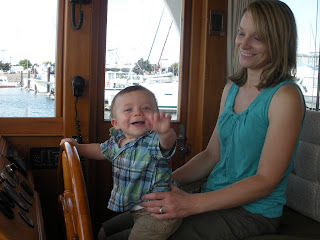
This past weekend we joined Grandma and Grandpa on their sailing trip in the San Juan Islands.


Ben helped Daddy and Grandpa steer the sailboat.


A good sailor always has a snack close at hand.


Ben also tried out his sea legs on Uncle Peter and Aunt Gerry's boat.


Tasting the wheel is an old Captain's trick for ensuring your crews safety.


Arr!


Monday, August 24, 2009

Favorite Sounds

Ben loves to blow raspberries.

All through the grocery store, car rides, in restaurants, on walks, in the swimming pool, to little old ladies at the retirement center, in bed at 4 in the morning ....everywhere.

Not always polite, but SUPER cute!

Saturday, August 8, 2009

Crawling?

Ben's on the move!

It's kind of a crawl, scoot, and drag with a half roll.

Definitely an A+ for effort!

He couldn't be happier with himself.

Sunday, July 19, 2009

Cousin Maddie

Ben spent a fun Saturday playing with his Cousin Madison.
.
.
She took Ben on his first ride down the slide

.
.
and pushed him in the swing.
.
.
Over and over.
.
.
Ben LOVES his swing and his Cousin Maddie!

Saturday, July 18, 2009

Daddy's Big Helper

This weekend Ben helped Daddy drive an excavator.


First they discussed the job.


Then, Ben learned exactly which controllers to use.


Finally, Daddy showed Ben how to play in the dirt.


Two happy boys with one big toy!


Tuesday, July 14, 2009

Garden Helper

Ben loves to help in the garden. Today we picked green beans.


Well... he picked a green bean.

Monday, July 13, 2009

A lesson in Genetics...

Today from the Genetic Counselors at OHSU called. The results of Ben's genetic testing had arrived.

Ben was tested for an
autosomal recessive disorder called Pendred Syndrome. Autosomal recessive is one of several ways that a trait, disorder, or disease can be passed down through families. An autosomal recessive disorder means two copies of an abnormal gene must be present in order for the disease or trait to develop. A mutation in a gene on one of the first 22 nonsex chromosomes can lead to an autosomal disorder.

Genes come in pairs. Recessive inheritance means both genes in a pair must be defective to cause disease. People with only one defective gene in the pair are considered carriers. However, they can pass the abnormal gene to their children.To have an autosomal recessive disorder two copies of the gene must be mutated for a person to be affected. One copy comes from the mother and the other from the father. The parents are usually unaffected and unknowingly each carry a single copy of the mutated gene (and are referred to as carriers).


If both parents are carriers, there is a 25% chance of a child inheriting both abnormal genes and, consequently, developing the disease or syndrome. There is a 50% chance of a child inheriting only one abnormal gene and of being a carrier, like the parents, and there is a 25% chance of the child inheriting both normal genes.

The results from Ben's tests show he has two mutated genes, what is expected with someone affected by an autosomal recessive disorder. One of the mutations is to a gene known as SLC26A4 on chromosome 7, which causes Pendred Syndrome. The other is a mutation that has not been seen before. The results stated the exact mutation is unclear.

Because Pendred syndrome is a recessive trait, a child needs to inherit two mutated SLC26A4 genes—one from each parent—to have Pendred syndrome. This means Ben's diagnosis is still a bit unclear. To determine if Ben truly has Pendred's both parents need to be tested to see if we are carries of the mutated gene. If we are carries, it is possible Ben has Pendred's with a mutation that has not yet been documented. Lucky Ben!

It is important to us to determine whether or not Ben has
Pendred's because it can cause some other complications for him as he grows older. Mostly, we will need to monitor his thyroid as he enters puberty. He may also develop some balance issues as he begins to try to walk.

All in all, the answer is good for Ben and good for us. It's a bit strange, in a way, to think that people can carry this mutated gene around unknowingly. If they have a child, that child may or may not be affected. It may never surface. But then again, it just might. Lucky, lucky Ben!

Monday, June 22, 2009

Sedated ABR

This week Ben had his first sedated ABR (Auditory Brainstem Response). The ABR evaluates how well sounds travel along the hearing nerve pathways from the ear to the brainstem (i.e how well he hears).

The ABR monitors changes in brain activity as repetitive clicking sounds are sent through the ear. The audiologist places four small stickers on Ben's head, chest, and ear lobes, connected to leads going into a computer. Sounds are be sent through an earphone to each ear separately while a computer analyzes the changes in the brain wave pattern in response to sounds.


In order for the results to be accurate, the brain needs to be relaxed. When Ben was younger, he was able to sleep peacefully for the ABR. Each time he would twitch or suck on his pacifier, we would see a change in his brain waves on the computer screen. Now, to have Ben's brain relaxed enough and for long enough, he needs to be sedated.

Ben doesn't mind the process at all- except that we had to starve him for 6 hours before the sedation. Nurses put numbing cream on his skin in several places so the I.V wont hurt as much.

A Sedation team administers the medication and Ben falls peacefully asleep. The hospital wont allow parents to stay with their children once they are fully sedated. Mom and dad have a few hours to wonder, eat and worry.

According to the ABR, Ben's hearing has not changed since his last ABR three months ago. We had a small bit of hope (or wishful dreaming) that his hearing would have improved somehow. But, we are also glad to have the left ear working just as strong. We know that with EVA
hearing loss is progressive. We would hate to have the hearing he currently has decline before he is implanted. In this case, December seems so far away.

Sunday, May 31, 2009

Water Fun!

Ben loves his bath. He splashes, gurgles, and tries to eat the wash cloth. But, he can't hear any of it because he has to have is hearing aids off.


So....we had some water fun outside.


Some splashing, no gurgling.


Ben spent most of his time looking at his feet.


I guess toes in the water look different with hearing aids on.


Don't worry Nadine. The aids are in the dryer tonight :)

Tuesday, May 26, 2009

One Step Closer

This week we headed up to OHSU to meet with their Genetic Counselors. Our goal is to find the cause of Ben's hearing loss.

After giving our family history (no congenital hearing loss on either side), Ben was given a physical exam. He is right on track with his growth and is meeting all the age appropriate developmental markers. We told the counselors about Ben's ABRs and how his MRI and CT scans were normal.

That's where we were stopped short. The counselors had reports from the scans we had not yet seen. Apparently, Ben's MRI and CT scans were not normal. The doctor noted that Ben has enlarged vestibular aqueducts.

So, what does that mean? It's hard to explain, and we are still learning, but this is what we know so far:


  • Vestibular aqueducts are narrow, bony canals that travel from the inner ear to deep inside the skull. The aqueducts begin inside the temporal bone, the part of the skull just above the ear.

  • A vestibular aqueduct is considered enlarged if it is greater than 1.5 millimeters in size, roughly the diameter of the head of a pin.

  • Scientists also are finding that five to 15 percent of children with sensorineural hearing loss, or hearing loss caused by damage to sensory cells inside the cochlea, have EVA.

  • The presence of EVA can be a symptom of a genetic disorder called Pendred syndrome, a cause of childhood hearing loss. Approximately one-third of individuals with EVA and hearing loss have Pendred syndrome. With Pendred syndrome, the hearing loss is progressive, which means that a Ben could have less hearing over time.

  • EVA may also be linked with balance problems.

  • No treatment has proven effective in reducing the hearing loss associated with EVA or in slowing its progression.

Through my many hours Googleing and reading posts on my favorite cochlear implant connection, cicircle yahoo group, I have found that quite a few kids have EVA and receive cochlear implants. Whew! Although there can be some extra complications, implantation is possible.

After letting our new discoveries sink in for a bit, we are actually relieved. Often, children with congenital hearing loss have other physical or developmental challenges that surface as the child ages. With the findings of the EVA we can let many of our fears go.

Our next step is to have Genetics counselors at OHSU test Ben for Pendred Syndrome. We'll worry about that when the time comes.

Sunday, May 17, 2009

Let the games begin!


Look what Ben found!


These things are so cool!


And tasty?


Mom has her own plan!


Thursday, May 14, 2009

Salem Heights

This week I had the opportunity to visit Salem Heights Elementary School. This is where deaf and hard of hearing children in three local counties are able to come together for mainstream education. The school provides sign language services and speech and language therapy specific to the kid's needs. My mom actually taught kindergarten there several years ago.

Quite a few of the kids at Salem Heights have hearing aids or Cochlear implants. I met with several kids who were excited to tell me all about their implants. They took off their processors and coils, proudly showing me how they hear. To these boys, Cochlear Implants and hearing aids are just a part of their lives. As natural as the shoes we put on each day.

I had conversations and played games with children who were deaf, just like Ben. It was enlightening to have a vision into Ben's future. I could picture him giggling with a group of boys or arguing over the rules of a game.

I brought a book about Ben's first day with his hearing aids to show the kids. One fifth grade boy, with an implant and a hearing aid, carefully read through each page of the book. He finished reading and said:

"What is your baby's name?"

"Ben"

"Is Ben going to get an implant too?"

"Yes. I think so."

"He will say: Thank you Mommy for letting me hear."

"Really?"

"He will say it was the best day of his life."


I smiled the whole way home. My baby has such a bright future.

Thursday, April 23, 2009

HB 2589

I just heard that HB 2589, the children's hearing aid bill, will be headed to the House floor with bipartisan support from the Health Care Committee. Only one member of the committee voted no, Ron Maurer, and it was noted that he very rarely supports mandates. This is great news! Within the next week or two, we should find out when the bill is likely to be up for a vote of the full House.

Anyone who is interested in contacting their state representative and urging his or her support of the bill is welcome to do so.

To find your representative:
http://www.leg.state.or.us/findlegsltr/home.htm

Scroll down to State Representative and the phone and email for your representative will be listed.

Thank you very much!

Wednesday, April 15, 2009

Growing Pains

Our little boy is growing up! He weighs almost 12 pounds and has grown three inches since birth! (If you know our family, you will understand how remarkable this height growth is!) He has outgrown his newborn clothes, rolls from tummy to back and back to tummy, holds his head up, and has even had his first cold- A true sign of childhood.

Ben's ears are growing at a rapid pace as well. He is already on his third set of ear molds, the soft plastic portion of his hearing aid that sits inside his ear. Ben's audiologist makes impressions of his ears and sends them to a factory. In two weeks ear molds return. Ear molds that are already too small for Ben's growing ears!


The microphone, on the top of the hearing aid, picks up sounds and sends them to an amplifier that makes them louder. After sounds are made louder, they go through the earhook to an ear mold. The ear mold's job is to hold the sound inside Ben's ear.


Since Ben's ear molds don't fit tightly, the sound leaks out- feedback. If you have ever been near a person whose hearing aids squeal, they have poor fitting ear molds. Ben's sound like bees buzzing around is head. Sometimes I can hear my voice coming from his ear...kinda creepy.

Here he is rolling like a champ! As he rolls, he loosens the ear mold. Ah, feedback!


Saturday, April 11, 2009

Ben Practices Politics


We first learned Ben had a hearing loss through the Newborn Infant Hearing Screening. Since 1999, when the Hearing Screening began, hearing loss has been found to effect 1 in 22 infants. Oregon mandated the Hearing Screening as a way to insure early identification of hearing loss. Early identification and intervention can prevent psychosocial, educational, and linguistic repercussions. Infants who are not identified before 6 months of age have delays in speech and language development. Intervention at or before 6 months of age allows a child with impaired hearing to develop normal speech and language. However, when it comes to interventions, often times hearing aids, health insurance companies lack support.

At more than $3,000 apiece for hearing aids and no help from insurance, many families are forced to make financial sacrifices or have their child go without hearing aids. Unfortunately, the identification of a child's hearing loss becomes a financial burden. Families become aware their child needs hearing aids, but are left without means for attaining them.

The issue of hearing aid insurance is heating up, and several states are responding with bills to require coverage of hearing aids for some people. This Friday House Bill 2589 was proposed to the House Committee on Health Care at the Oregon State Capital. The passing of this bill would require insurance companies to pay a portion of pediatric hearing aids.

Ben and I attended the committee meeting, along with several experts in the field of pediatric hearing loss. Ben did a fantastic job modeling his hearing aids for the committee while I told our story. Hopefully we tugged at some heart strings. This is what I said:

Finding out your baby is deaf is like being hit with a pile of bricks. Invisible bricks. He was warm and soft and snuggled in my arms. He looked perfect. How could something be wrong? But, at twelve hours old, I was told he failed his hearing test. Impossible. The nurses must have botched the test. But still, through the denial, I felt pain coming from somewhere.

At two weeks old, we took our baby to get another hearing test. He failed. The dull, throbbing pain of those invisible bricks returned. I could have sworn he flinched when we banged the pots and pans over his head desperately tying to perform our own hearing tests.

After a visit to an ENT, a different audiologist, and two more hearing tests we had our answer. Our son is deaf. All the “I love you” whispers and lullaby tunes had truly gone unheard. He’ll really never know my voice? The bricks pushed so hard I couldn’t breathe. That long, deep exhale of relaxed contentment, of a world full of bright futures and sunny skies that exists in the world of our son were crushed by the dark news of which I had just heard.

I’m his mother. My job is to fix what goes wrong in his world. I hung on the glimmer of hope provided by the audiologist: “He may be able to hear some sounds with a hearing aid.” Hearing aids would be the answer. I knew it.

I researched and found that with my son’s severe loss, he would need high powered hearing aids. Expensive hearing aids. Our insurance doesn’t cover hearing aids. We couldn’t deny our child a chance to hear. Sacrifices could be made. We have a car we no longer drive. Someone might buy it. My husband could work longer hours. I could cut my maternity leave short. Those bricks grew heavier.

We were lucky. Blessed. The Willamette ESD loaned us hearing aids to see if our son responded to sound. On April 1st, at 9 weeks old, my son tried on his first pair of hearing aids. As we snapped the battery door shut, we held our breath. I didn’t know what to say.

“Ben it’s mommy.” He opened his eyes. He looked at my face. He heard my voice.

My son wears his hearing aids whenever he is awake. He smiles more. He enjoys Patty Cake, and Twinkle Twinkle. We listen to Mozart. I can soothe him with my voice when he cries and he hears my goodnight whispers.

If we were not able to borrow hearing aids, my child would be missing these sounds. Soon we will need to buy Ben his own pair of hearing aids. Unfortunately, the high cost of the hearing aids creates a barrier for families like ours. Our insurance does not cover any of the expenses associated with hearing aids. Sacrifices will need to be made. It is not fair that Ben should have to get less expensive, less effective hearing aids, or our family have financial constraints.

We pay for health insurance to cover our family’s medical needs. My child’s eyesight is covered. Why not his hearing? Should he be denied the opportunity to attend regular education classes, develop normal speech, and listen to Mozart?

Friday, April 3, 2009

MRI and CT


Today we spent a long day at OHSU. We arrived at 7 am to have Ben sedated for a MRI and a CT. The nurses began by putting a cream on Ben's hand and feet to numb the skin over his entire body. After forty minutes, the cream worked and Ben was ready for his IV. He was dressed in a hospital gown, given a light sedation medication, hooked up to a blood pressure monitor, and given oxygen. Once he was fully sedated, the nurses wheeled him away for the scans. In an hour and a half a groggy little boy returned. He took a long time waking up and orienting himself.


We also met with Dr. McMenomey, OHSU's cochlear implant surgeon. He has preformed over 1,000 implant surgeries and averages around sixty each year on children. Dr.McMenomy feels very strongly that a child should be around a year old before getting an implant. After learning more about the surgery itself, we agreed.

The actual surgery takes 2 to 4 hours, a long time for babies to be sedated. It involves securing the receiver/stimulator under the skin and inside the skull, and then threading the wires containing the electrodes into the spirals of the cochlea. The internal portion of the implant includes a strong magnent for ataching the external portion.

To secure the receiver/stimulator, the surgeon first makes a small depression in the temporal bone (the skull bone that contains part of the ear canal, the middle ear, and the inner ear). Next, he opens up the mastoid bone behind the ear to allow access to the middle ear. Then, a small hole is drilled in the cochlea and the wires containing the electrodes are inserted. The implant is then secured and the incision is closed. Swelling is minimized by applying a pressure bandage. Babies usually need to stay over night, but adults can go home the same day.


Two to four weeks after surgery, the sound and speech processor is matched with the implant and is programmed and fine-tuned to meet the child's individual hearing needs (This is the portion of the implant you see on the outside of the head.).

After reviewing Ben's scans, Dr. McMenomy feels Ben is a perfect candidate for a cochlear implant! This means Ben could be implanted before Christmas and hearing before his first birthday. What great gifts!

Wednesday, April 1, 2009

Ben can hear!


Today Ben got his hearing aids!

Ben was asleep while his dad put on the first hearing aid in his left ear. When he closed the battery door and turned the aid on, Ben's eyes opened. He looked around the room with wide eyes. He kept looking to left to find where the sound was coming from. It was wonderful! Our little boy heard our voices for the first time!


Look at those smiles!


He loves to hear!